5.31.2010

Outrider Playtest Marred By Car Trouble.

Ironic, I know.

I drove all the way to Austin without a hitch. Got to the Protospiel convention without troubles. It all happened on the way back from lunch. My wife was on her way back to bring me some food and blammo ... the electrical system on our car goes haywire. We spent Saturday night and Sunday morning running around trying to get our car serviceable enough for a trip back to Abilene. Long story short: it had to be towed. I missed out on a good deal of the convention and I missed Steve Jackson. Oh well, there's always next year.

The Good News

Yes, there is good news in all of this. I did get in three solid sessions with some great testers and I spoke at length with a couple of reps from Steve Jackson Games, who were intrigued by the game and gave me some solid 'marketable' advice. Mostly ways to make the game economical to make, sell and appeal to a wider audience than just the semi-hardcore tabletop crowd. I may not make use of all of the suggestions, but they did have alot of common sense advice that will definitely be used.

Outrider is Changing Again

Isn't that what this blog is about? Alot of reaction I got from players at protospiel, including the SJG employees was focused on a few areas that don't seem to fit with the elegance and quickness of the core concepts (such the card maneuvers, the dice mechanics) ... the main culprits were the collision system (again), loss of control mechanics, the HUGE amount of modifiers that have crept into the system and the Skill Point system. I'm not saying these pieces will be removed, but they certainly will be streamlined. Although a typical game hovered around an hour, alot of people commented on how 'slow' the game felt at times. I have some solid ideas for quickening the pace:
  1. Collisions will be simplified ... again. I'm thinking of digging thru some older rules and resurrecting a simplified system
  2. Loss of control checks will be quicker to resolve and less 'harsh' in some instances
  3. Alot of the current modifiers will be removed, leaving mainly the vehicle characteristics as the only source of modifiers
  4. The driver check system will be removed, but most other skill point mechanics will remain the same
That's about it for now, check your mailboxes soon for Outrider v.61!

5.25.2010

T-Minus Four Days and Counting


Friday, May 28th marks the beginning of Protospiel South, a gaming convention devoted to playtesting and prototyping board, card and tabletop games.

I will be attending Protospiel South 2010, with Outrider v.60 in tow. I hope this version proves, through testing, to be the final revision. I feel there will be no more major revisions beyond this point. I hope to be able to shift my focus to creating artwork, working on the graphic design and producing prototypes to be shopped around to various publishers. I am also working on creating a small pre-printed four player set that I plan on selling at game cons and at a few local comic/game stores.

The public demos will continue, as long as the local game stores will allow. The next public demo will be at Specialties, a toy and game store in San Angelo, TX. Details are still being hammered out at this point, but it will likely be sometime in June. This will be followed by another appearance at Premier Comics in Abilene, TX.

Thanks again to all the playtesters that have helped shaped this game into a much better game than I had imagined ... We've come a long way from hand-drawn cards and coffee-stirrer rulers.

Two New Vehicles Debut at Protospiel

At present, there are seven basic builds included in the rules. I recently gave a rundown of these vehicles on this blog. I've always been a bit nagged by the fact that I don't have an eighth build - it would help round things up for printing purposes. The two current candidates for the eighth slot are:

The Trailblazer

The Trailblazer distills several strong elements from other cars. Articulated front arc - check. Rear arc - check. Handling Bonus - check. Firepower Bonus - check. The Trailblazer could become the ubiquitous Outrider vehicle. It's a great, versatile build ... so good in fact, that I fear that NO ONE would EVER choose to use another build.

Jarhead

The other build is a bit experimental. The Jarhead represents a ex-military vehicle retrofitted for Outriding. Featuring an overlapping articulated primary arc and secondary arc, the Jarhead can pack quite an offensive punch when the arcs line up on the same target. Essentially a rolling gun, I'm curious to see how well it works in practice.

For more information on Protospiel South 2010, follow this link:


5.19.2010

To Ram or Not To Ram ... ?

You can't have a game of vehicle combat and not include rules for collisions/ramming; Not matter how hard you try, collisions will occur. Some due to poorly planned maneuvers and others due to reckless players who WANT to run into things(!)

The reason I am writing this post, is to present to you (the playtesters and the curious) my NEW thoughts on ramming and explain WHY these decisions were made.

First off, I want to stress that ramming has changed many times during the development of Outrider, possibly more than any other aspect in the game. The central reason for most of the tweaks was to find a simple way to replicate a complex situation.

A few requirements I have put on collisions, in order to 'fit' with the 'feel' of Outrider

  1. Quick resolution: Collisions & Rams should be  resolved in ONE (1) opposed roll.
  2. Pseudo-Simulation: Although Outrider is far from realistic in terms of physics, I wanted collisions to feel plausible. Some early concepts had vehicles moving too much or too little
  3. Balanced: From early on, I didn't want any single aspect to be game-breaking. If Ramming became absolutely superior to shooting, what appeal would their be in building a gun-centric build. I wanted every aspect of the car to be important and a potential cornerstone to a winning build.
Given those self-imposed requirements, I present the latest treatise on collisions. The newest concept added to collisions, is to create three separate collision types that are a mixture of ARMOR + (Attribute). This makes different vehicles better at performing certain types of impact maneuvers. Here is a brief rundown of the collision types.

Boxed in

Not really a collision, but rather a set of circumstances that prevent a collision. effectively, Boxed-In is a rule stating that a stopped car cannot initiate a collision with it's first maneuver card. This is to prevent players from spamming each other with new collisions after a loss of control of other collision.

Clipping

Clipping is a new maneuver that is used either to evade a potentially damaging collision or to spin an opponent without the risk of taking damage. The driver’s skill and the vehicle's handling are important factors in this type of collision.

Ramming

Ramming is used when the desired result is all-out destruction to the target car, regardless of the damage done to one’s own vehicle. Putting the pedal to the floor, the speed of the engine lends dangerous momentum to the crash. Ramming is nothing more than an intentional collision. It is a no-holds-barred maneuver that will result in damage for both of the vehicles involved. Ramming is a desperate but powerful maneuver.

Blitzing

With a quick slap of the fender to put them off their stride, the attacker strikes while the guns are in the foe’s belly. Blitzing is similar to a clip maneuver … with guns! Blitzing is a new brutal combo of reckless driving and gunnery maneuvers that can spin out and damage the target vehicle. This maneuver was created to answer the age old playtesting question: Can I fire my guns while ramming? Now the weapon die can be used in collisions.

Incidental Collision

Whenever a pile up occurs, cars are going to scatter and incidental hits are sure to happen. Whenever a vehicle is repositioned, due to a collision or other event, and it is pushed into the area of influence of another vehicle, an incidental collision has occurred. Incidentals have been happening more and more in games. Most incidentals end with all vehicles involved coming to a halt at the point of impact with no damage - usually because the displacing event is likely to have absorbed the damaging momentum ... and because its just easier to pick up and move on, game-wise ... well okay that isn't always true - see the next bullet point ...

Colliding with Obstacles and Terrain

Terrain elements can be involved in collisions. In most cases, colliding with objects and structures will inflict zero, one or two points of damage and bring a vehicle to a dead stop at the point of contact with no rolling necessary, depending on the type of terrain impacted. Some smaller objects will inflict no damage at all, but may still stop a car. There are many obstacles that may trigger special effects. Terrain specifics will be covered by special rules included in the scenarios rules as the properties of certain elements may change from scenario to scenario.

Any ideas or thoughts on collision mechanics? I'd love to hear them.

-G

5.14.2010

Playtesting, Weapons and Damage ... Oh my!

I know I promised info on weaponry, but I wanted to take a moment and discuss they public demo of Outrider that occurred this past Saturday, as a lot of changes came out of those seven sessions. We had a few surprises at the event. After listing the demo in the community calendar, we drew a few interesting guests. The local paper sent a reporter and photographer to event - the resultant article has generated a good amount of interest. We even had people from Reveal Entertainment (a game/toy company in Abilene, TX) showing up, thinking that the event was a public demo of one of the company's products that they had not heard of ...

There are some changes to be made based on that extended demo. Most of the changes will come to the way that collisions are handled, as the present rules are a real bog, even to players that are familiar with the game. It helped me tremendously to see new players come to the table with no prior experience and see what areas they struggled with. I came away with absolute areas to focus on.

But enough of my yakking ... we've talked cars, not it's time to talk GUNS, GUNS, GUNS!

Weapons in Outrider

Over the course of the game's development, the weapons have gone through many changes. In the game's humble beginnings, there was no mention of the weapons, other than a firepower stat and a weapon arc. Later incarnations yielded specific mentions of 'parodied' weapons (i.e.TYN-E10 'Tiny Gun' standing in for the M134 Mini Gun, etc.). When secondary arcs were added, the idea that ALL arcs were the same gun seemed counter intuitive.

The feedback I received from play testers was wonderful. I'll admit - I don't know squat about real ballistics and Hollywood and video games have skewed our perceptions. We've come to believe that the mini gun and the shotgun are unbeatable relics - not to belittle them, by any means. I just had the ranks 30 cal/50 cal/mini gun/cannon floating in my head all throughout development and I received LOTS and LOTS of emails, making cases as to why one weapon would outperform another.

Well, after taking that knowledge and spending some time building models to match the various builds, it occurred to me that there was no need to move into a more detailed direction - in fact taking a step back to the abstract may be better. I can simply give my car a WEAPON rating and then model it the way I want. Let's say I have a WEAPON rating of D12. I could say it was a 30mm Auto Cannon strapped to the roof or maybe it's twin M2 50 cals on the hood ... get the idea? The arcs (primary and secondary) stay the same, but it grants the player a little leeway in modeling the vehicle. It also allows one model to be used for multiple builds.

All that being said, I still have a ranking system that helps players visualize the construction of their vehicles. The lists below denote the range of possible weapons a WEAPON die could represent.

Small Arms & Light duty Machine Guns

This class includes infantry-level weapons that have been modified by Outriders to be vehicularly-mounted.
The most common type of weapon found on Outriders’ cars, due to their cheap cost and wide availability.
Weapons in this category would include modified SMGs, Assault rifles and the occasional belt fed machine gun like an M1919 or M60 (pictured).


Medium Duty and GP Machine Guns

Any that requires a bipod on stanchion usually qualifies. This is a hard class to define. Typically, it ccould be represented by doubling up on MG-42s or FN MAGs or distilling that firepower into one weapon that doesn't go up in caliber, but way up in ROF, like the M134 (pictured). I've found more mini gun minis than possibly any other weapon for modding cars.


Heavy Duty MGs & Anti-Vehicle Weaponry

This class includes weapons that cross the line from anti-personnel to anti-vehicle classification. The bigger calibers of this class equal increased armor penetration. This is where Ma Deuce resides (M2 Browning). Which to rank higher, the M134 or the M2? This issue has been one of the longest ongoing debates. As impressive as the M134 is, I think it's gotten it's fair share of pub from movies and games. So I thought I'd show the M2 Browning a little respect ... I mean it was/is used as AA, AV and used to be mounted in the wings of fighter planes(!) Other weapons in this class would include the M85 (pictured), DShK, NSV/Kord MGs.

Heavy Ordinance & Friggin’ Artillery

A class of large, weapons more at home on tanks, the explosive shells of these weapons can shred through just about any vehicular armor with ease. This is sort of a catch-all category for stuff that would likely blow a car-sized object up with one hit. Well in our fantasy universe, it takes six! This class may be the most open to interpretation of all, as it can include things such as the M242 Bushmaster (pictured), the M230 Vulcan all the way up to 120mm cannons used on tanks. Ive even had a few players model their cars with missiles/Rocket Pods (below) to represent this grade of armament.

Yes, but what does it all mean?

All and all, at present, I'm just encouraging players to model cars the way they like and just let the vehicle bases and dice allotments govern the details. If they want to switch from game to game, all it takes is a card and dice swap and the same model can go from fast attack vehicle to Rammin'Stein and still be 'legal' to play. The speed and the fun factor have always been at the center of this design. Some people want high levels of ballistic detail and other just want to roll dice NOW!

I'm not claiming that Outrider is a simulation (far from) but I think it works in a way that many can understand, while still holding a bit of tactical depth that can keep veteran players interested.

NEXT UP: Collisions and ramming and why I hate them (lol)

5.05.2010

Outrider Vehicles: A Breakdown

With the (local) public debut approaching this weekend I thought I would give a brief rundown of some of the concepts present in Outrider, focusing on the vehicle builds and weaponry choices.

Outrider's Rides

My love of cars is at the core of Outrider's design. I wanted to create a system that allowed players to start with a template and then customize it. Currently in Outrider, there are only seven vehicle builds but almost daily I think of ideas for more. Below is a list of those basic vehicles and a brief description of each.

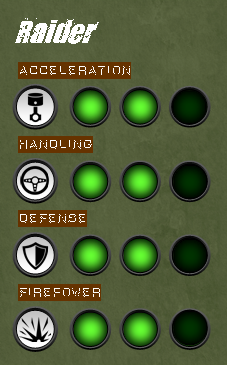
Raider: Jack of all Trades

Raiders are the the most common vehicle to be encountered in the Southwestern Wastes. The reason is simple: They're cheap to make and they're fairly balanced and durable. With no complicated automation and with only one main weapon anchored in a fixed-forward position, there's little to go wrong.

Vehicles Used: Any. Raiders can be made out of Dune Buggies, Trucks, although many are built out of old passenger cars, trying to camoflage themselves as townie/civilian vehicles. That can make them very dangerous to the careless traveller.

Pros: Extremely well balanced attributes. Raiders are fast, nimble, tough and dangerous.

Cons: Due to their simplistic construction, Raiders typically are left offensively blind on the sides and to the rear. Smart Outriders can use this to their advantage - But beware groups of Raiders - they can cover their blind spots well.

Renegade: Scourge of the Southwest

Most Renegades began their Outriding existence as Raiders. Over time, weight (and armor) was shed to make a faster, better handling vehicle with less punch, but more flexibility. Bandits, Highwaymen and militias alike keep more than a few Renegades around to use as a go to vehicle for strike and fade situations.

Vehicles Used: Most Renegades are scratch-built rail-jobs (dune buggies) or stripped-down passenger cars; although it's very common to see one built from the remains of a truck and military GP.

Pros: Renegades are quick and their excellent handing can make improbable feats of driving seem easy. The wide frontal sweep of the Renegade's weapons can be extremely deadly.

Cons: Renegades sacrifice armor in favor of speed/agility. A solid hot from even a light weapon can devastate a Renegade fast. A lot of 'Riders will put inexperienced drivers in Renegades, thinking the crisp handling will save them.

Interceptor: Pavement Predator

Most Outriding jobs involve making runs across the desert wastes. It's advantageous to use the highways, when you can - and Interceptors own the highways. Capable of break-neck speeds, drivers of Interceptors always seem to be one step ahead of their opponents. Some superstitious 'Riders claim they can outrun bullets. Most law enforcement agencies employ Interceptors. Some smugglers have been known to use Interceptors for super fast runs.

Vehicles Used: A lot of Interceptors are pony cars, sports cars and perhaps the occasional exotic.

Pros: Fast. If equipped properly, can maintain an edge over other vehicles.

Cons: Lack of weapon hard points. High speeds can lead to many losses in control if too many risky maneuvers are performed back to back.


Gunslinger: Badlands Drifter

Outriders live a brutal life. The unspoken terms on any Outriding job is that someone will probably be killed during the run and if you want to get paid, that someone ain't going to be you. Gunslingers are built with for one purpose: deal death and deal it quick. Typically wielding twin-linked weapons on its front fenders or on it's flanks, Gunslingers evokes the image of a grizzled gunfighter standing, hands hovering over his pistols ready to draw. Some even look like mini attack copters on wheels.

Vehicles Used: Gunslingers are almost uniformly made up of muscle cars and street rods, as a certain reputation must be upheld. Although occasionally other vehicles will crop up as Gunslinger builds.

Pros: Powerful positive capability. Gunslingers can drive and shoot with he best of them. Paired with the right driver, Gunslingers can hit hard and get away quick.

Cons: Gunslingers share the same type of weaknesses as the Interceptor and other fixed-weapon builds. The vehicle has a large blind spot and can't handle hug amounts of punishment - but if you strike first, that may not be a problem.


Linebacker: Swiss Army Knife on Wheels

So many attempts have been made to make a truly versatile vehicle. Most of those attempts have been left smoldering and rusting in the West Texas sun. The Republic of Texas Linebacker is one the few versatile builds that has worked well enough to generate copycats. Originally developed as a backup for Texas Ranger Interceptors, the Linebacker has come into its own as a frequent one-car army. Brandishing the twin front guns of an Interceptor/Gunslinger, the Linebacker adds a rear-firing weapon to deter chasers and to help close-up its fixed-weapon blind spots.

Vehicles Used: Texan Linebackers are typically made from large sedans or small to midsized SUVs. Linebacker copies have used large, antique cars, (mini) vans and various types of wagons.

Pros: Multiple hard points and as durable as any truck.

Cons: Slower than most other builds, the Linebacker also tend to be a bit unforgiving in demanding driving. Many drivers are lulled into the assumption that versatility means doing a lot at once - this is a bad trap to fall into with such a heavy vehicle.


Tailgunner: Battin' Cleanup

Tailgunners are a vehicle that was born out of necessity. A large percentage of Outriding jobs involve escorting a convoy of some sort. At a minimum, any convoy needs one vehicle to lead and one to tail or 'sweep.' It became clear quickly that riding in that sweep position was very dangerous. Outriders had to find a way to protect their six and still be able to defend the convoy if necessary. Turning the primary weapon backwards and aiming the secondary towards the front, Tailgunners are the ultimate escort vehicle.

Vehicles Used: 99% of all Tailgunners are pickup trucks of some variety. It's possible to modify a SUV or van to serve as a Tailgunners and quite o few station wagons have shown up, mimicking the Tailgunner build.

Pros: Wide rearward-sweep keeps enemies off your tail. Tailgunners make great support vehicles and can be brutal with the right parings.

Cons: The Tailgunner sacrifices any formidable forward firepower to sustain a large weapon at the rear. Like other truck builds, the Tailgunner tends to be slow and has sluggish handing


Muleskinner: Beast of Burden

Muleskinners are by far the most important of all other vehicles. That's because they are built to haul (and protect) cargo. As to what that cargo is ... is not always your business but it needs to get there safe(!) The downside to all this is that Muleskinners are often the target if attack and if spotted, will usually draw the attention of unwelcome guests.  To this end, Muleskinners have been built to outlast other vehicles, since they typically cannot out run or out gun them.

Vehicles Used: Muleskinners are made from vans, delivery/moving trucks and the occasional armored car. Station wagons, SUVs and similar vehicles have been used to draw less attention.

Pros: Tough as all get-out, Muleskinners can live through things that would have destroyed other vehicles.

Cons: Slow, Mushy handling. The Muleskinner has a limited fire arc as most of it's interior and exterior have been devoted to armoring and cargo space ... leaving no room for weapons, ammo or the automation needed to provide good coverage.

Well that covers the vehicles in the base game (stay tuned for more!). As promised, I will be covering weapons in the next post (as this one ran a bit long).